
正义的伙伴
China reports 522,000 new COVID-19 cases, one death in July amid fluctuating upward trend_我的网站

一 |

China reported 522,000 newly confirmed COVID-19 cases in July, including 487 severe cases and one related death with cases showing a fluctuating upward trend, China's national disease control authority said.
The current uptick in infections represents another regular cyclical wave, with its severity comparable to surges seen in the past two years. The upward growth curve has slowed markedly, and the country is now on the plateau phase of this epidemic peak, said the Chinese Center for Disease Control and Prevention (Chinese CDC) on Thursday.
All tested infection samples were confirmed to be the Omicron variant, with the NB.1.8.1 strain and its sublineages accounting for the majority of circulating cases, the Chinese CDC said.
A Beijing-based respiratory disease specialist told the Global Times that waning population immunity, continued virus mutations that weaken existing antibody protection, and increased summer travel have contributed to the recent modest rise in infections. However, there is no evidence that the virus has become more pathogenic. Nationwide infections appear to be nearing their peak and case numbers may begin falling in late August.
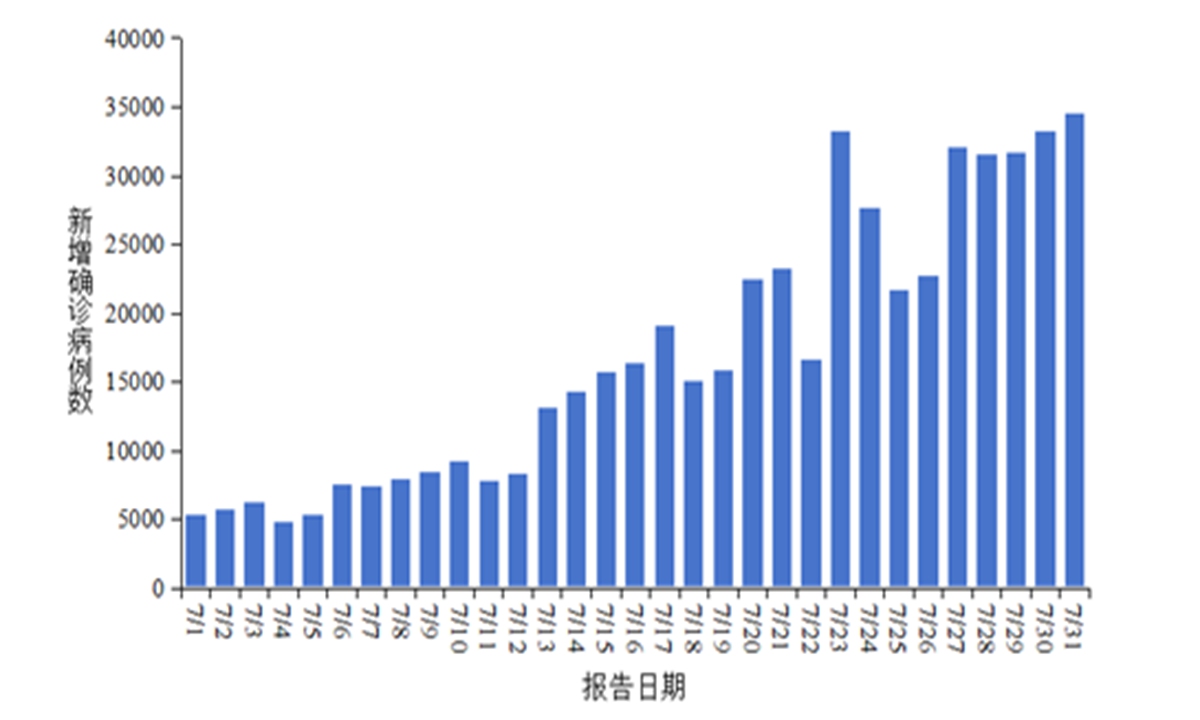
According to sentinel hospital surveillance data, from June 29-July 5 to July 27-August 2, the proportion of influenza-like illness among all outpatient and emergency visits at China's 1,041 COVID-19 and influenza sentinel hospitals edged up with slight fluctuations, standing at 4.3 percent, 4.4 percent, 4.5 percent, 4.4 percent and 4.5 percent, respectively.
During the same period, the COVID-19 positivity rate among patients with influenza-like illness in outpatient and emergency departments rose for consecutive weeks.
Several factors drove the fluctuating rise in COVID-19 cases in July. Population immunity has waned, as more than six months have passed since the last major wave of infections for most people, while continued SARS-CoV-2 mutations have reduced the protection provided by existing antibodies, Li Tongzeng, a respiratory disease medic from Beijing You An Hospital to the Capital Medical University, told the Global Times on Friday.
These factors, combined with increased travel and population mobility during the summer vacation, contributed to the recent small-scale surge. Based on patterns observed in recent years, COVID-19 infections tend to rise every six to eight months as population immunity declines, said Li.
The expert noted that while the virus continues to mutate, there is no evidence that it has become more pathogenic. Clinical data show that most patients develop only mild symptoms, with very few progressing to pneumonia or requiring hospitalization.
The Chinese CDC noted on Thursday that since COVID-19 was reclassified as a Category B infectious disease under Category B management, it has evolved into a prevalent, recurring respiratory infectious disease in China, with one to two epidemic fluctuations occurring nationwide each year.
Li also noted that residual immunity from previous infections also helps reduce disease severity, with most reinfections presenting as mild upper respiratory symptoms that resolve within about a week. The single COVID-related death reported nationwide in July further indicates that the current fatality rate remains very low.
Judging from historical epidemic patterns and current case growth trajectories, national infection figures may begin to decline in late August. Nationwide case numbers are now nearly at their peak, with declines already observed in some regions, said Li.
The Chinese CDC also said on Thursday that surveillance had not detected any variants posing major public health risks, nor had the current wave caused notable disruptions to the healthcare system.
The public is advised to take appropriate protective measures, including wearing masks when necessary, maintaining good personal hygiene, adopting healthy lifestyles and getting vaccinated as recommended.
。 近期,中东地缘局势持续紧张,航运通道存在扰动风险,直接影响到了全球化工品的供应链,不少化工品价格同步走高,化工板块也逐渐成为市场新焦点。Wind数据显示,7月20日以来中证细分化工产业主题指数累计上涨10.50%,超越同期上证指数(6.01%)、沪深300(4.34%)的表现。

二 | (数据来源:Wind,截至2026.8.18。下同) 化工板块行情回暖的背后,多重中期配置逻辑正在积累。一方面,行业供需格局改善信号逐步显现,景气度有望持续修复;另一方面,板块经历前期调整,估值已回落至合理偏低区间。在此背景下,景顺长城中证细分化工产业主题ETF(场内简称:化工ETF景顺,基金代码:158032)正式发行,为投资者提供一键布局细分化工龙头的便捷工具。 价格先行:一条从3930到5515的曲线 事实上,化工行业作为经济的“骨架”——从手机屏幕到汽车涂料,从化肥农药到锂电池材料,它无处不在,却鲜少成为市场焦点。

三 | 过去三年,这个行业更是被市场 “用脚投票”:产能过剩、价格低迷、利润承压,板块在底部反复摩擦。但2026年以来,数据开始讲述一个不同的故事。 中国化工产品价格指数(CCPI)是观察行业景气最直观的窗口。Wind数据显示,2026年1月4日,CCPI报3930点,处于近年低位。

四 | 此后,随着WTI原油从年初约57美元/桶一路攀升至8月18日的85美元/桶(布伦特原油同期站上90美元上方),成本端推动叠加供需改善,CCPI一路走高,年内最高触及5515点。截至8月18日,CCPI报4879点,较年初上涨约24%。 价格回升的传导效应已在二级市场显现。Wind数据显示,长江基础化工指数近一年累计上涨23.11%,其中中证细分化工产业主题指数近一年涨幅更达27.82%。

五 | 供给重塑:供给侧的三重推力 价格回暖只是表象,更深层的变化发生在供给端——这是本轮化工周期区别于以往的关键。 第一重推力来自产能周期的自然出清。Wind数据显示,化工行业资本开支增速近两年显著回落,在建工程同比增速转负,标志着本轮扩产周期已进入尾声。

六 | 新增供给的边际放缓,为价格修复提供了基础条件。

七 | 第二重推力来自政策端的系统性约束。“反内卷”被写入“十五五”规划,多个化工子行业通过协会倡议、联合减产等方式主动约束供给;“碳排放双控”体系于2026年正式落地——4月,中办、国办印发《碳达峰碳中和综合评价考核办法》,化工、石化行业被纳入全国碳市场扩围名单。工信部等七部门印发的《加力推进石化化工行业老旧装置更新改造行动方案(2026—2029年)》则从存量改造维度推动落后产能退出。多方政策合力之下,行业从“拼规模”转向“拼质量”的路径或已不可逆。 第三重推力来自海外竞争格局的此消彼长。据东兴证券研报统计,2022-2025年,欧洲化工厂关停数量增长6倍,累计退出产能约3700万吨,同期新投资规模从270万吨降至30万吨。高能源成本正加速欧洲化工产能的萎缩,中国化工龙头的全球份额持续扩大。

八 | 需求端同样出现了新旧动能的切换。传统地产链需求依然疲弱,但汽车、家电、纺服等中下游保持平稳,而真正值得关注的是增量部分:AI算力扩张带动电子氟化工、高纯电子化学品等新材料需求放量;碳纤维在风电叶片与商业航天领域加速渗透。在出口端,海关总署数据显示,2026年1-5月,我国化学工业及其相关产品累计出口约962亿美元,累计同比增长20.3%,5月当月同比增速更高达29.1%——在全球地缘冲突频发的背景下,中国化工供应链的稳定性正转化为实实在在的全球竞争力。 估值等待:市场尚未定价的改善 Wind数据显示,截至2026年8月18日,中证细分化工产业主题指数的动态市盈率(PE-TTM)为21.20倍,市净率为2.59倍,处于历史中枢附近,并未出现明显高估。

九 | 而行业基本面已较一年前发生结构性改善:2025年第四季度起,化工板块盈利触底回升,2026年一季度营收与净利润同比继续改善。

十 | 多家券商在2026年中期策略中判断,随着供给端产能扩张接近尾声,需求端整体复苏,市场交易逻辑正由前期的“估值修复”切换至“业绩兑现”。这种“利润向上、估值不高”的错配,构成了当前化工板块配置价值的核心逻辑之一。 在此背景下,正在发行的化工ETF景顺(代码:158032)值得关注。这只ETF将紧密跟踪中证细分化工产业主题指数,该指数当前成份股50只,申万二级行业分布中,农化制品占比27.39%、化学制品24.74%、化学原料12.90%、炼化及贸易11.93%、电池9.54%、塑料7.09%、化学纤维3.24%、航空装备Ⅱ1.08%,覆盖了上游资源到下游新材料的化工产业链。前十大成份股权重合计43.44%,在龙头代表性与组合分散性之间取得较好的平衡。(数据来源:Wind ,截至 2026/8/18) 据了解,当前市场上有多只化工相关指数,特征各有差异:中证石化产业指数风格更偏向上游资源属性;中证全指化工指数成分股覆盖面更广,中小市值标的占比更高。相较而言,中证细分化工产业主题指数赛道纯度更高,同时适度纳入石油石化、电力设备、军工新材料等方向标的,既锚定化工产业基本盘,也能捕捉产业升级带来的成长弹性。当然,周期从不会是一条笔直的上扬线。CCPI在年内触及5515点后回落至4834点,提示着价格修复并非一蹴而就;原油成本端的波动也会持续扰动化工中游的利润分配。但对于关注化工板块周期修复机会的投资者,可通过化工ETF景顺(158032)这类指数化产品,一键布局化工全产业链细分龙头。 还值得一提的是,化工ETF景顺(158032)的发行,也意味着景顺长城在周期及资源品ETF领域的布局进一步完善。近年来,公司围绕相关方向持续落子,已形成覆盖石油天然气(石油ETF景顺)、有色金属(有色ETF景顺)、电力(电力ETF景顺)、粮食与农牧渔(粮食ETF景顺、农牧渔ETF景顺)等多只产品在内的周期品类矩阵。此次化工ETF景顺的发行,使景顺长城的周期品类ETF矩阵进一步完善,从上游的石油天然气、有色金属,到中游的化工、电力,再到下游的农牧渔,基本覆盖了周期产业链的核心环节。这不仅为投资者提供了更丰富的周期板块配置工具,也体现了公司在细分赛道指数产品布局上的持续深耕。责任编辑:郭栩彤。
Current article:http://7oly6r.ningshunsaotuiqiao.shop/9tc/20260826/7919387.html
Published on:12:48:35